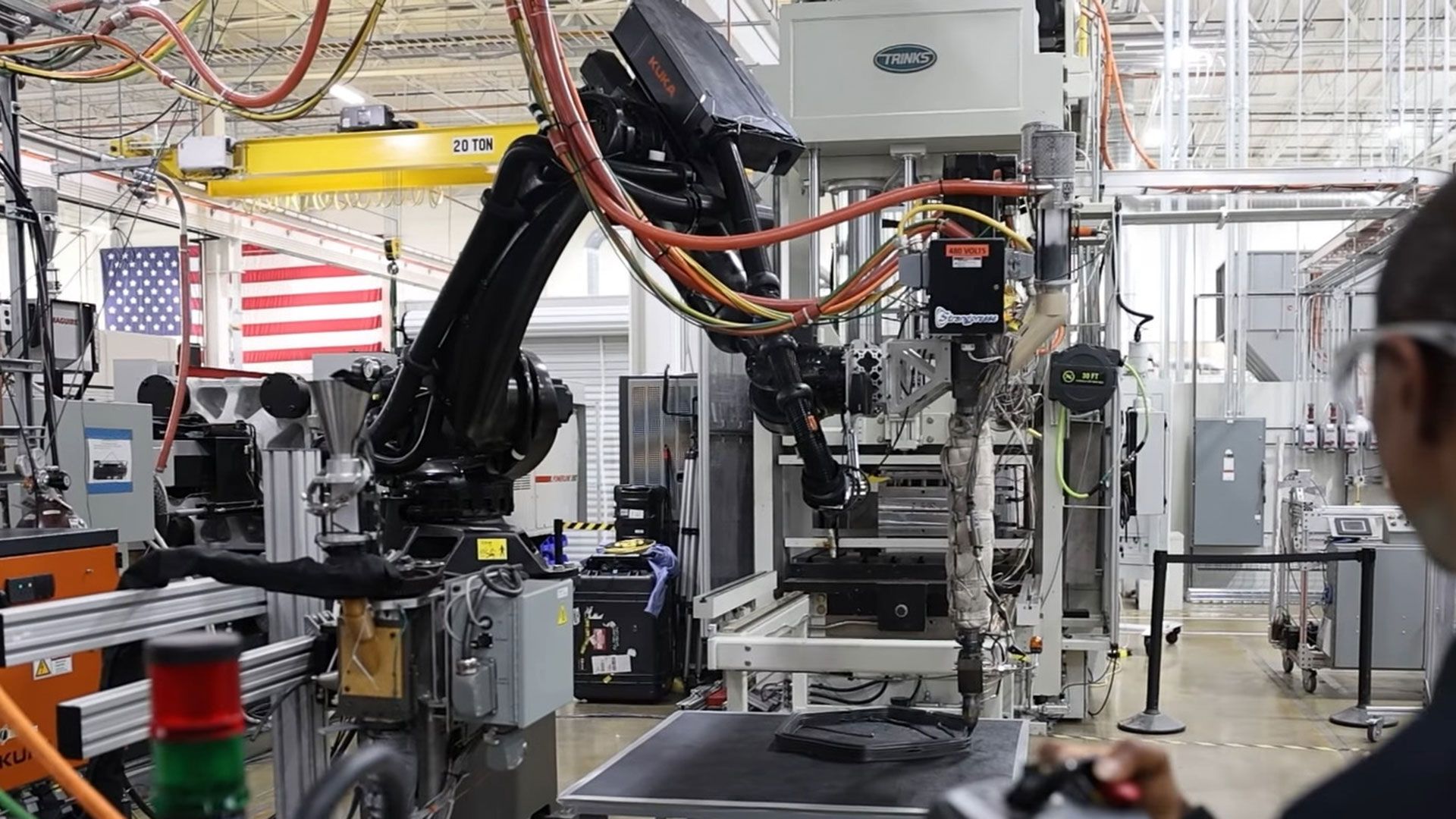
Oak Ridge National Laboratory has demonstrated a multiplexed nozzle system that combines the output of multiple extruders into one molten polymer stream, enabling different materials to be deposited at the same time. The approach targets a persistent challenge in large-format additive manufacturing: increasing output while retaining control over slower, more detailed printing operations.
As Tom’s Hardware reported on September 30, the Department of Energy laboratory’s latest demonstration builds on technology it first revealed in 2023. ORNL describes the system as a way to scale extrusion without the usual penalties associated with making a single extruder progressively larger.
Why larger extruders become difficult to control
Large objects require substantial material throughput if they are to be printed in a reasonable amount of time. Increasing extruder size can provide that output, but it also adds weight to the equipment that a gantry or robot must carry and position.
ORNL identified two connected problems in its 2023 explanation. Heavier extruders require stiffer, more expensive motion systems. They also suffer from unreliable flow control when operating below 10% of maximum throughput, creating difficulties for small builds and operations that require slow deposition.
That leaves large-format equipment with competing demands: enough output for substantial parts, and sufficient flow control when the toolpath calls for less material.
Multiple extruders feed a single polymer stream
ORNL’s approach combines several extruders through a multiplexed nozzle. Their output becomes a single stream of molten polymer, with individual contributions controlled to adjust the overall flow.
When less material is needed, one of the multiplexed feeds can be switched off. This provides a way to reduce deposition without relying solely on a large extruder running at a small fraction of its capacity.
The demonstration also describes adding more extruders to raise throughput while preserving quality and control. ORNL presents reduced weight penalties and improved low-speed reliability as benefits of the architecture. The demonstration does not specify an upper limit on the number of extruders that could be combined.
The central idea is modularity: scale the material supply through multiple extrusion units, with control over which units contribute to the deposited stream.
Multi-material beads could gain internal structure
The same arrangement supports simultaneous delivery of different materials at controlled rates. Its potential extends beyond changing materials between separate regions of a print.
ORNL points to ribbon and core-and-sheath bead designs formed directly at the nozzle. These configurations would give the deposited bead a deliberate material arrangement, making the nozzle itself part of how a multi-material structure is produced.
The laboratory identifies additive manufacturers, marine applications and aerospace as intended areas of use. A commercial release date has not been announced in the reporting.
A different approach to multiplexing than Rutgers’ MF3
Multiplexing has also appeared in research using a different printing architecture. In August 2022, 3D Printing Industry reported on the Rutgers and University of Louisville MF3 system, which used several printheads on one gantry to deposit material concurrently in different areas.
That system relied on a custom slicer to control each nozzle’s deposition independently while the printheads shared the gantry’s movement. ORNL’s demonstration instead brings multiple extruder outputs together into one polymer stream.
Both approaches address the relationship between throughput and deposition control. For Oak Ridge, the next industrial step is applying its combined-stream architecture to the large-format applications it has identified, including marine and aerospace manufacturing.