Introduction
3D printing has revolutionized manufacturing, particularly for producing customized products and prototypes. However, many 3D printers still suffer from relatively high failure rates. Researchers from Carnegie Mellon University’s Department of Mechanical Engineering have developed an innovative system that uses multiple large language model (LLM) agents working together to monitor and correct 3D prints in real time, significantly aiming to reduce print failures.
The Challenge of Print Failures
Despite advances in additive manufacturing, error rates remain a significant issue. Prusa3D reported about 7% failure rate on prints using their MMU2S printer, with an additional 19% of prints requiring user attention without outright failure. While occasional failures and monitoring are manageable for hobbyists, they become problematic at scale in manufacturing.
Historically, manufacturers targeted failure rates around 5% in the 1980s. Modern standards have tightened to around 0.1%, rendering a 7% failure rate inefficient and wasteful. This hinders the competitiveness of 3D printing compared to other manufacturing methods.
The AI-Powered Solution
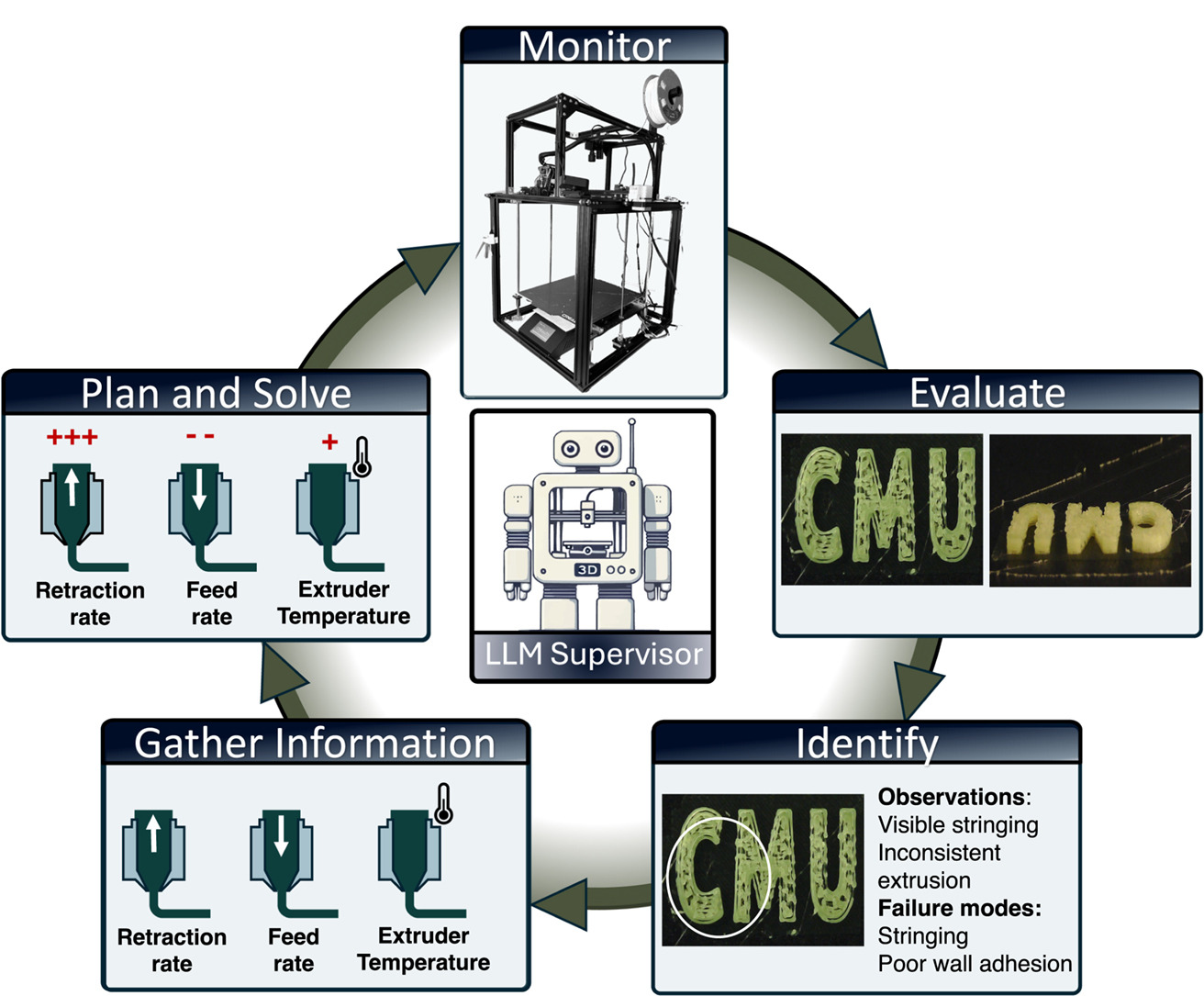
To address this, the Carnegie Mellon team designed an AI system employing five specialized agents:
Visual-Language Model Agent – This agent captures photos of each printed layer, analyzing them for defects and print quality issues.
Printer Settings Agent – It reviews the printer’s current settings and identifies adjustments needed to correct the detected problems.
Solution Planner Agent – Based on the insights, this agent devises an actionable correction plan.
Executor Agent – Interacts with the 3D printer’s API to implement the planned changes and achieve the desired printing outcome.
Supervising Agent – Oversees all other agents to ensure relevant and up-to-date information flow and coordination.
The system stands out because it uses base ChatGPT-4o models and general domain-specific prompts rather than custom-trained LLMs. This approach simplifies implementation and adaptation across different printer makes and models.
Implications and Future Directions
Associate Professor Amir Barati Farimani of Carnegie Mellon highlighted the adaptive nature of the future of manufacturing through AI integration. As LLMs evolve to process richer multimodal data, they will unlock greater capabilities in precision and reliability.
If widely adopted, this AI system could enable 3D printers to self-monitor and self-correct without human intervention, potentially ending the era of manual print babysitting. Until such autonomous systems become mainstream, users must continue manual oversight to prevent failures and print defects.
Conclusion
The Carnegie Mellon research presents a promising advancement toward intelligent and autonomous manufacturing systems. By leveraging multiple LLM agents in a modular, coordinated design, the system aims to drastically reduce errors in 3D printing, improve efficiency, and bring additive manufacturing closer to industrial-quality standards.
As this technology matures, it could transform how 3D printing is approached in both professional and casual settings, paving the way for truly smart fabrication processes.