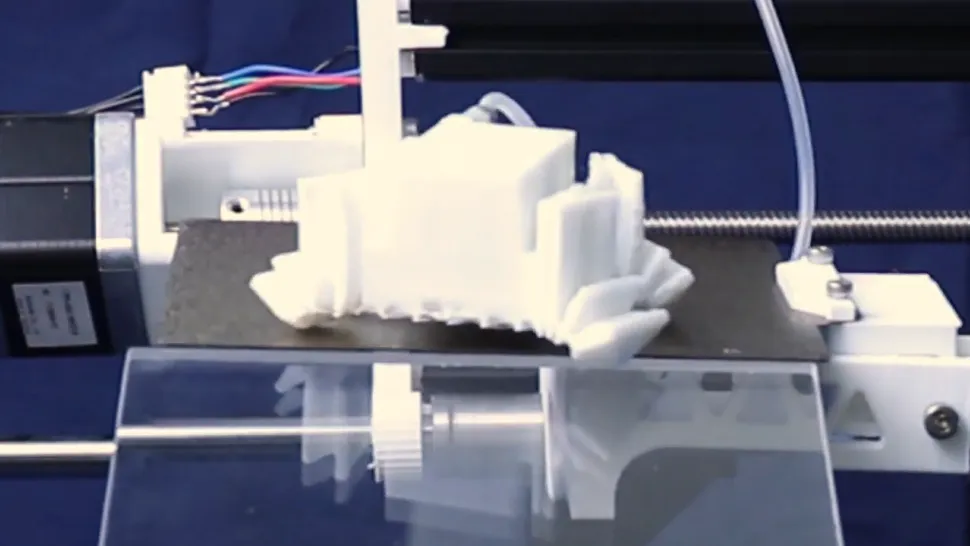
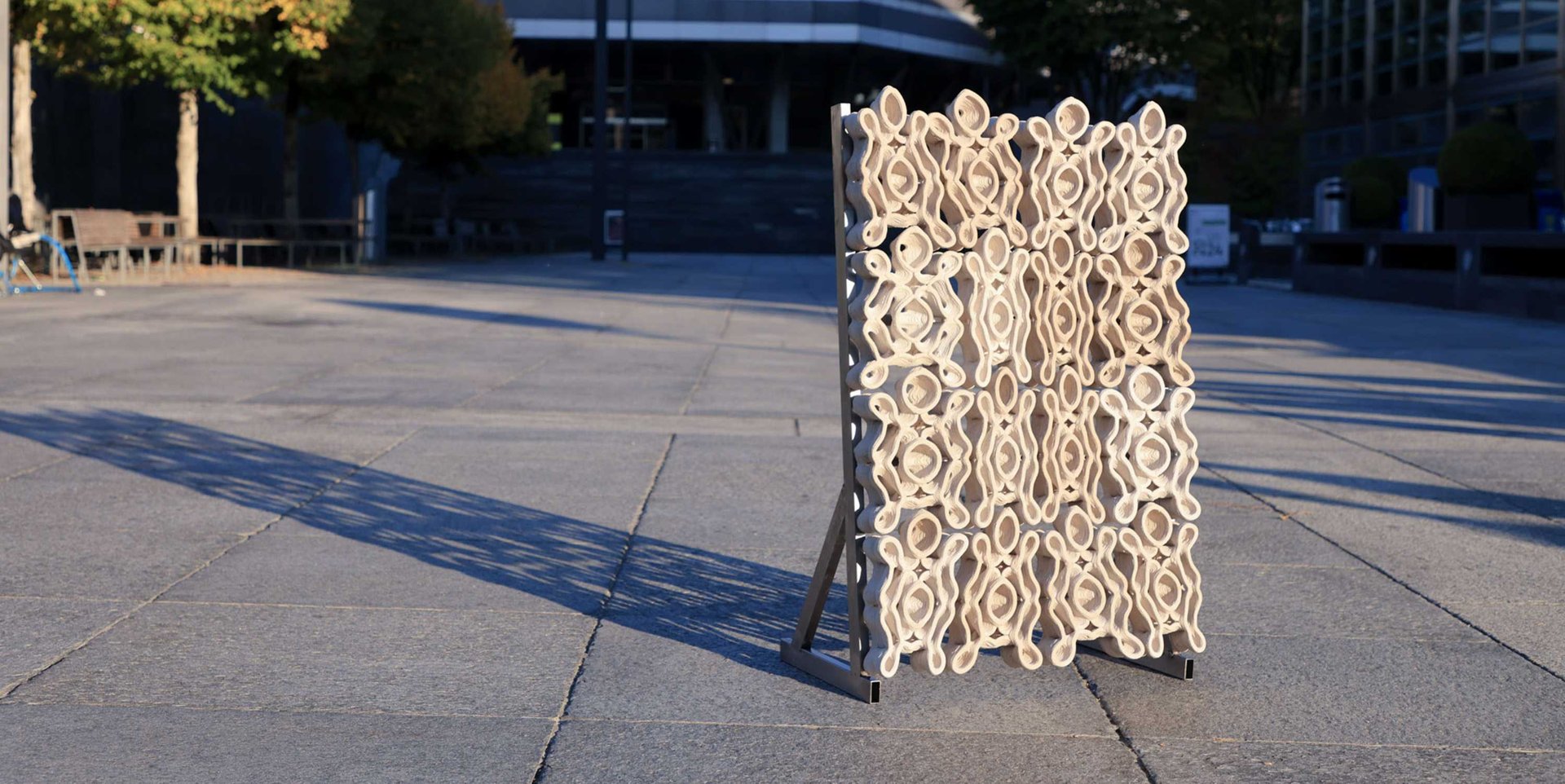
Adding more infill is not always the best route to a stronger print. In bacteria-hardened sand structures developed at ETH Zurich, open internal grids let a mineralizing solution penetrate farther, producing a larger strength improvement than denser layouts.
The work, led by architect Karen Antorveza Paez during her doctoral research, combines robotic extrusion with biocementation: bacteria help grow mineral crystals that bind sand grains together. Rather than printing conventional cement, the team prints a bacteria-containing paste and hardens it afterward without a cement kiln.
The results point toward non-structural architectural components, not a replacement for load-bearing concrete. They also show why the internal geometry of a print matters when its final properties depend on a biological process.
Bacteria grow the mineral bonds after printing
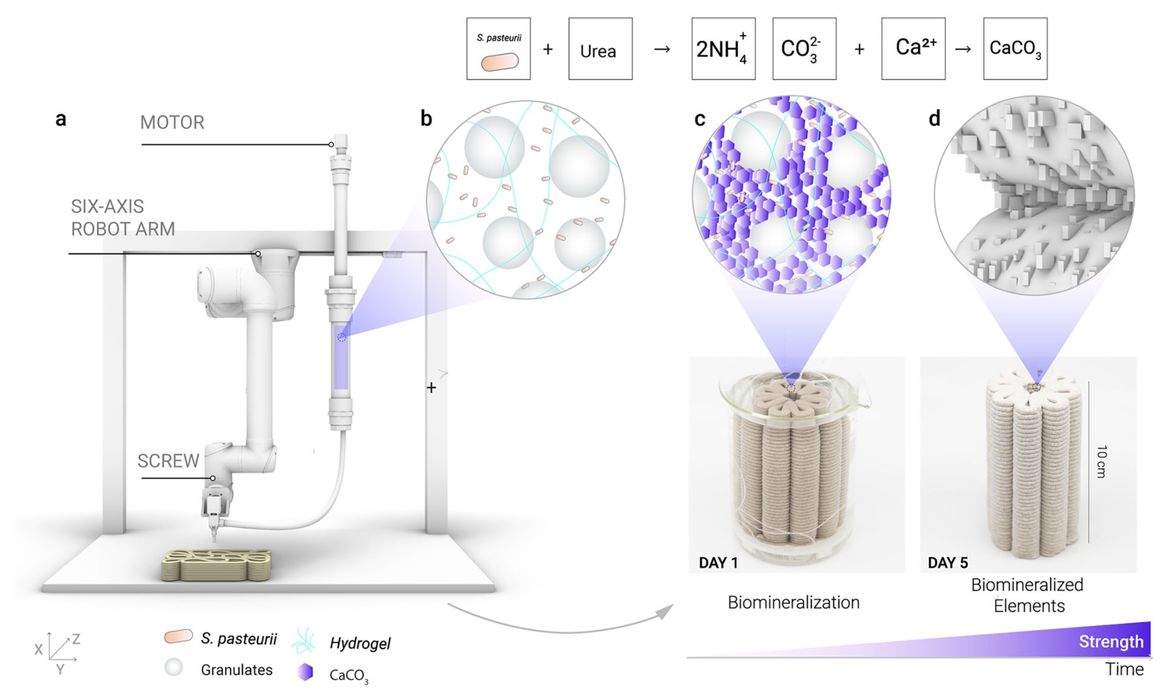
The printable bio-ink contains sand, living Sporosarcina pasteurii bacteria and a water-based gel incorporating alginate and xanthan. A robotic extrusion system deposits it in layers to create the desired shape.
The printed object then goes into a bath containing urea and calcium chloride. Using the enzyme urease, the bacteria break down the urea, releasing carbonate ions and ammonium. The carbonate reacts with calcium in the solution to form calcium carbonate.
Those microscopic crystals develop between sand grains and across neighboring extrusion lines. Their interlocking growth mechanically binds the printed material together.
This process is known as microbially induced calcite precipitation, or MICP. Mineralization takes several days, with the bath refreshed daily to replenish its ingredients. The object is then dried, leaving a solid mineral structure in which the bacteria are no longer active.
Biocementation itself is not new. Researchers have previously investigated it for soil stabilization and self-healing concrete. This work applies it as a material-making process for digitally fabricated architectural elements.
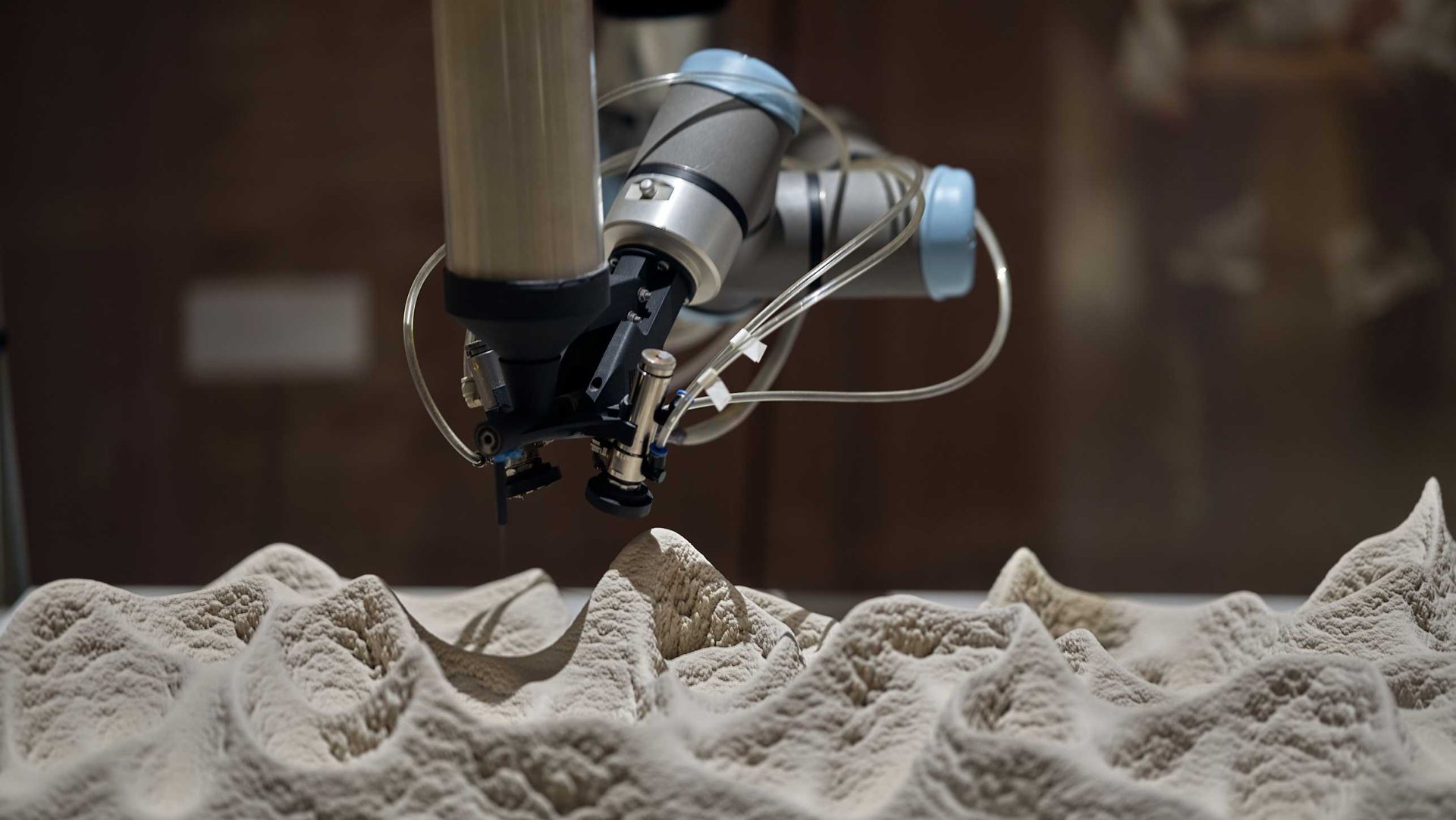
Open grids give the mineralization bath better access
The research published in npj Materials Sustainability examined how printed geometry influences mineral formation and mechanical performance.
The team tested 44 mm cubes with dense and sparse internal grids, using three or four specimens per condition. Open grids allowed the treatment solution to reach deeper into the objects. Denser layouts developed hardened outer regions, while their interiors received less mineral reinforcement.
The sparse grids accumulated 31.4% calcium carbonate, compared with 22.4% for the dense grids.
With bacteria, the sparse specimens showed compressive strength improvements of 61% to 86% over equivalent specimens without bacteria, depending on the loading direction. Dense grids did not show comparable improvements.
The percentages compare bacterial treatment with untreated equivalents. They do not, by themselves, establish that every sparse structure is stronger than every dense one.
The practical finding is that infill controls more than material usage. It also determines access for the chemistry that creates the mineral bonds. Packing in more material can restrict that access, limiting the benefit of bacterial treatment.
Lower-temperature processing still has environmental costs
Conventional Portland cement production generates CO2 through both high-temperature processing and the chemical conversion of limestone. Bacterial mineralization avoids the cement kiln, making it a potentially lower-emission alternative.
The research paper cites earlier life-cycle studies suggesting CO2 reductions of around 37% to 38% compared with Portland cement when favorable nutrient and calcium sources are used. That is a conditional finding from earlier studies, not a demonstrated emissions saving for every printed component.
Nor does this process capture atmospheric CO2. Its carbonate comes from supplied urea, while chemical production and bacterial cultivation carry their own environmental costs.
Urea breakdown also generates ammonium. Treatment or recovery of that byproduct will be essential before the process can be considered environmentally practical at scale.
Architectural screens are closer than structural concrete
Tested compressive strengths were roughly 0.5 to 2.2 MPa, well below structural concrete. For now, the material belongs in non-structural applications.
The researchers nevertheless printed a complex architectural element measuring 30 × 20 × 20 cm, suggesting possible uses such as facade screens, sun protection and partitions. Moving beyond these demonstrations will require reliable mineralization in larger components, alongside workable chemical sourcing and ammonium management.