Students at Mexico’s University of Guadalajara have developed a recycled-plastic filament that, according to the team, allows 3D printed prosthetic hands to interact with phone and tablet touchscreens. Called Filna, the project combines plastic waste with nanomaterials to give printed parts functionality beyond their structural role.
The work brings together students from the University Center of Guadalajara, CUGuadalajara, and the University Center of Tonalá, CUTonalá. Their goal is to broaden access to hand prostheses while addressing a practical requirement for users: operating mobile devices.
From printing prostheses to developing the filament
Filna began as an effort to 3D print prostheses. Working in the field of prostheses and orthoses led the students to focus on the material itself, with cost emerging as a central concern.
Uriel Aranda Rodríguez, a biomedical technologies student at CUGuadalajara, described the shift:
“We make filament for 3D printing, using recycled materials and nanomaterials that give the filament another function, aside from a structural one.”
Uriel Aranda Rodríguez, biomedical technologies student, CUGuadalajara
Aranda Rodríguez said the team found that people who need prostheses can struggle to afford them. That experience shaped Filna’s attempt to develop a more accessible alternative through recycled feedstock and material formulation.
Affordability remains a project objective. No prices or cost comparisons with conventional prostheses have been announced.
Nanomaterials add touchscreen interaction
To produce the filament, the students sourced waste plastic, shredded it, processed it with heat and incorporated nanomaterials. They worked toward a formulation suitable for 3D printing, with the additives providing the properties needed for interaction with mobile-device screens.
Aranda Rodríguez linked that choice to demand for prostheses that work with phones and tablets. Rather than concentrating solely on the shape of a printed hand, the project puts some of its functional requirements into the printing material.
That gives Filna two connected areas of development: reusing discarded plastic as feedstock and adding capabilities relevant to prosthetic-hand users. The touchscreen application is the current focus, while further material properties remain under development.
An Enactus award and two planned material additions
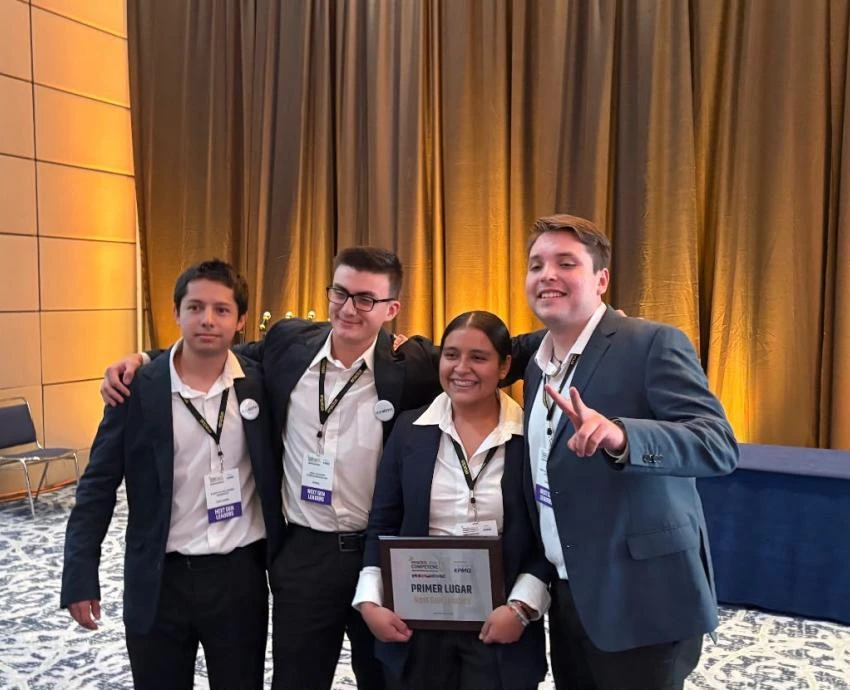
Filna won first place in the Next Gen category at the Enactus Mexico 2026 national competition in August. Alongside Aranda Rodríguez, the team includes Rodolfo Yael Ibáñez Rodríguez, Brenda Lucía Muñoz Sánchez and Eduardo Cornejo Magdaleno.
The students are continuing development with mentors Jacob Durán and Alejandro Campos. Planned additions include fluorescent properties for possible medical applications and biodegradability. Both are development goals, rather than established features of the current filament.
Recycled plastic also supports medical training tools
Filna is part of a broader student-led effort to use waste plastic for medical applications where commercial products can be difficult to afford.
In Poltava, Ukraine, medical students working as Alium established a small 3D printing laboratory using recycled PET from local waste, including bottles collected at their dormitory. They produce centrifuge and lamp parts, microscope elements, anatomical bone models and dental training blocks.
Alium’s work responds to a shortage of affordable, accurate educational models. Its output serves laboratory and training needs, while Filna’s continuing materials work targets hand prostheses and their interaction with everyday digital devices.