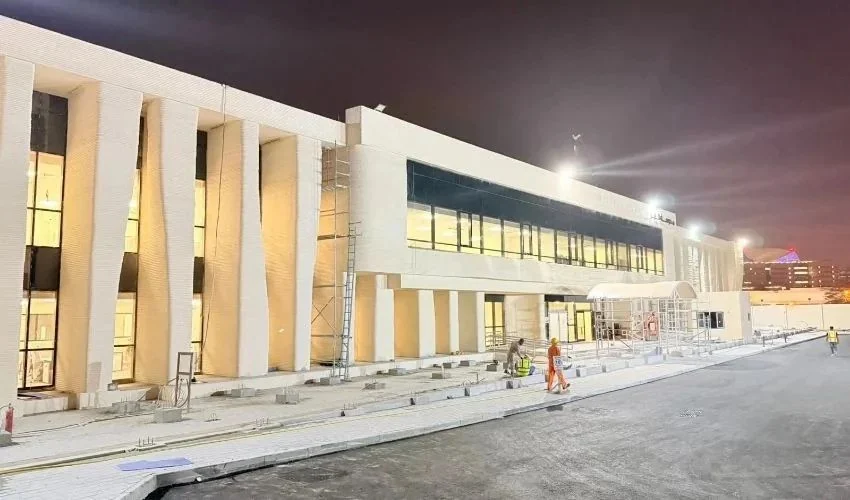
A school in Qatar is moving from concrete printing to roof installation and interior finishing, with 30,000 square meters of printed wall surface reported for the building. UCC Holding says the project is taking its final shape as windows, doors and other finishing elements are installed.
The school has been described as the “largest 3D printed building ever constructed,” according to 3Dnatives. What the reported figures do show is a construction project whose scale required repeated printer relocations and a lengthy wall-printing phase.
Two printed schools within a 14-school program
The building is part of an initiative covering 14 public schools, but only two are being constructed using 3D printing. Each of those two schools is described as a two-story building measuring 20,000 square meters.
COBOD’s 30,000-square-meter figure measures the first school’s wall surface, not its floor area. COBOD also reports more than 500 kilometers of deposited layers for those walls.
A 50-meter printer still needed repeated moves
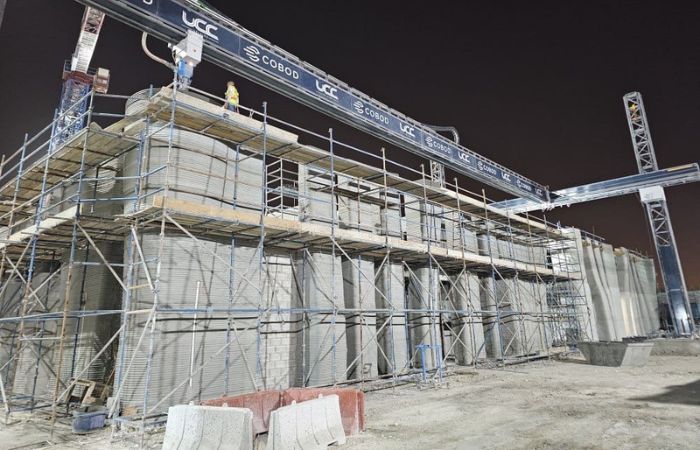
Wall production used a COBOD BODXL 3D concrete printer, measuring 50 meters long, 30 meters wide and 15 meters high.
Even at that size, the machine could not cover the entire school site from one position. Each school occupies a plot measuring 100 meters by 100 meters, so printing had to proceed in separate sections.
3Dnatives describes 15 cycles of disassembly, relocation and reassembly to reach the required areas.
Those relocations are an important part of the project’s practical story. The printer’s dimensions alone did not determine how much of the building could be produced in one setup. Covering the site also depended on moving and rebuilding the equipment between printing positions.
Printing began in June 2025, with walls nearly complete by July 2026
The project launched in 2025, and concrete printing began that June. By July 2026, the walls were reported to be nearly complete, with the fall marking the official end of printing work.
3Dnatives suggests that construction may have fallen behind schedule.
Printing was carried out at night to protect the concrete from the heat. That working pattern accompanied the production of undulating walls intended to recall the dunes of the Qatari desert.
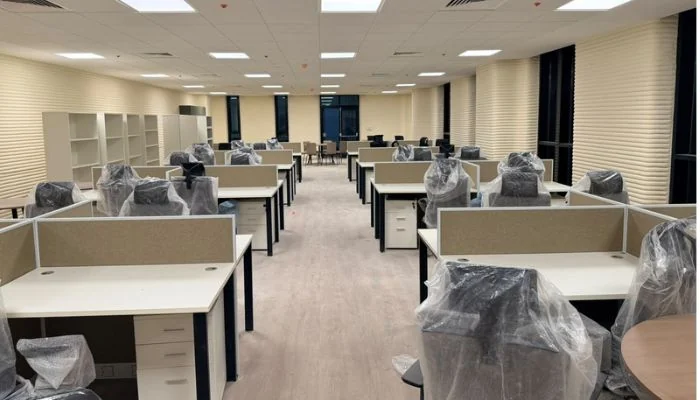
Dune-like walls give way to finishing work
3Dnatives credits additive construction with making those curved forms practical, describing conventional construction as either unable to achieve them or too costly and time-consuming.
With wall printing finished, attention has shifted to the roof, windows, doors and interior finishes. Students are expected to occupy the school soon, according to 3Dnatives.