Bambu Lab’s parent company, Shenzhen Tuozhu Technology, has filed a US patent application for a heatbed that routes a heating element through a recessed bed body. The proposed design aims to distribute heat more evenly and improve print adhesion, with the heater extending toward the corners of the printing surface.
Published on September 10, 2026, patent application US20260264331A1 describes the bed’s construction and heating arrangement. Tom’s Hardware reported on the filing on October 8, highlighting its potential to reduce peeling on large prints, alongside possible manufacturing costs that could make replacement beds more expensive.
A recessed heater replaces the laminated heating sheet
The central change is how the heater attaches to the bed. Tom’s Hardware describes the existing construction as a laminated heating sheet bonded to an aluminum sheet, with magnets holding the removable build plate in place.
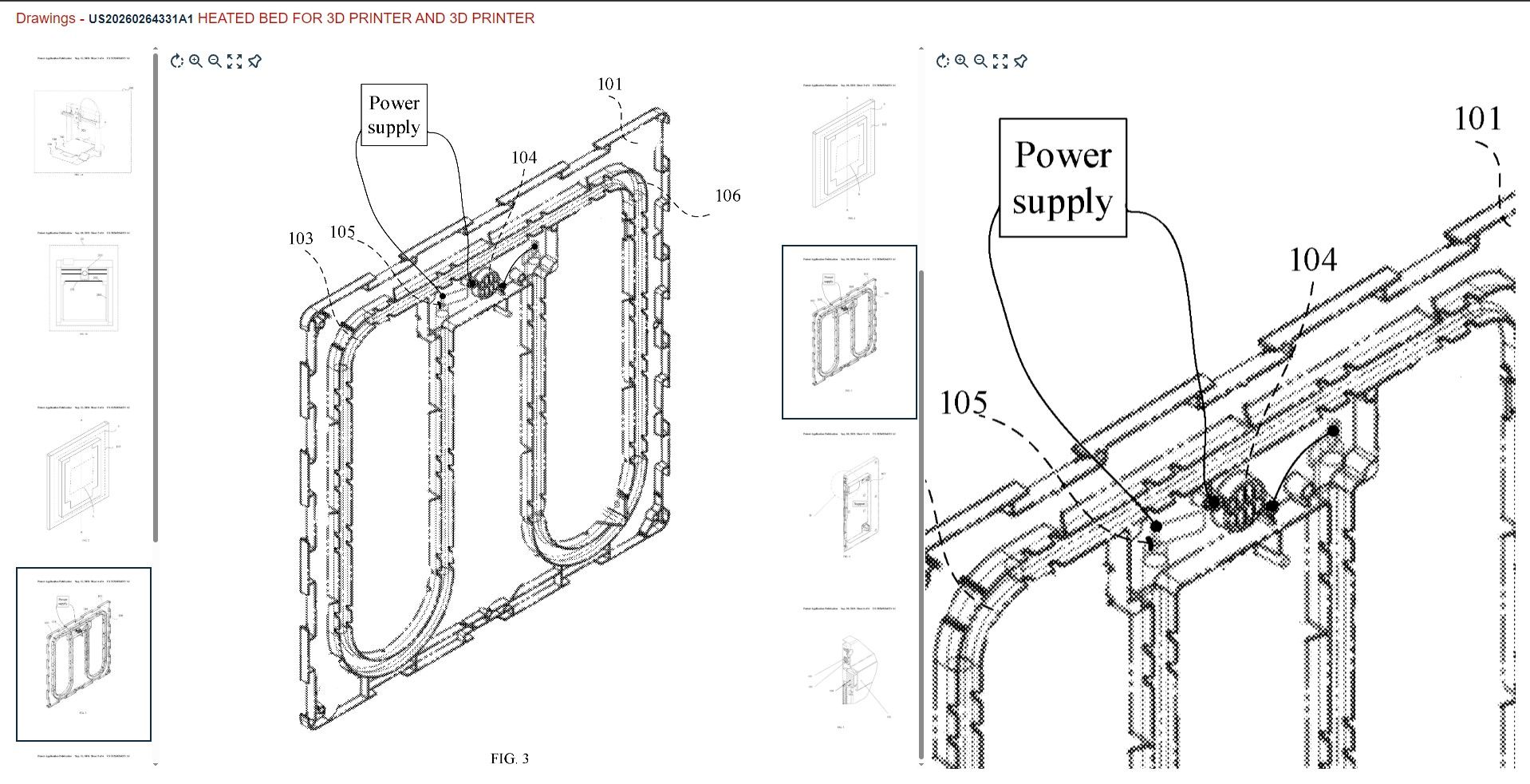
The application instead describes a heated bed body, a heating unit and a bottom case. The heater sits between the body and the case, attached to the underside of the bed body. Its two ends connect to the power supply.
Figure 3 appears to show a single-piece bed body with a channel for the heating element. Claim 5 describes the recess using a shape resembling the Chinese character “凹,” meaning sunken or depressed. That recessed path is the key physical feature of the proposal: it accommodates the heater within the bed body rather than relying on the laminated heating arrangement described above.
The application claims improved adhesion and print quality from this construction.
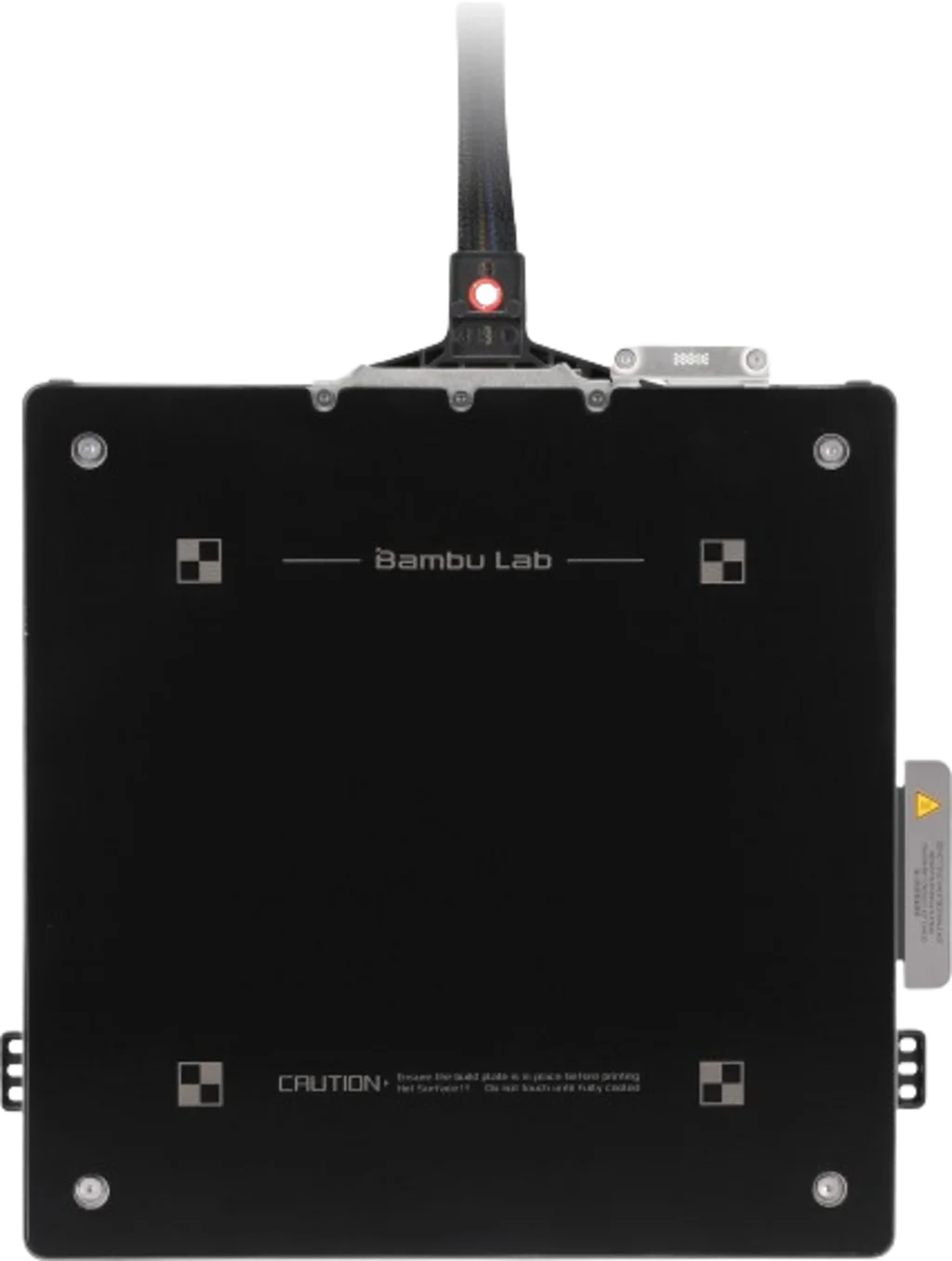
The heating path reaches toward the corners
The heater follows a looping route through the recess, reaching the corners of the bed. That layout could be particularly relevant to large parts occupying most of the build surface, where the proposed distribution of heat may help reduce peeling. Tom’s Hardware also suggested that the arrangement could shorten the time needed to reach a target temperature.
The filing describes one continuous heating unit connected to a power supply at either end. It does not describe independently controlled heating zones.
Performance data for the proposed design has not been reported, leaving its actual temperature uniformity, warm-up time and effect on adhesion unquantified.
Manufacturing choices could affect replacement costs
The apparent single-piece construction raises a practical question: how would Bambu Lab manufacture it?
Tom’s Hardware noted that machining a recess into a large aluminum piece could be expensive in both material and machining costs. It also raised the possibility of assembling the bed body from multiple pieces or layers of aluminum sheet, avoiding a large billet.
Those remain possible manufacturing approaches rather than confirmed production details. Higher replacement-bed prices are likewise a possibility raised by Tom’s Hardware, with no announced pricing for this design.
Printer claims remain tied to the heatbed
The application also includes claims describing a CoreXY printer. According to Tom’s Hardware, those printer claims are tied to the proposed heatbed construction, rather than covering the CoreXY arrangement broadly.
The report described the related PCT application as still pending. The filing therefore leaves two separate developments to watch: how its claims progress through examination, and whether Bambu Lab brings this recessed-heater construction into a production printer or replacement bed.