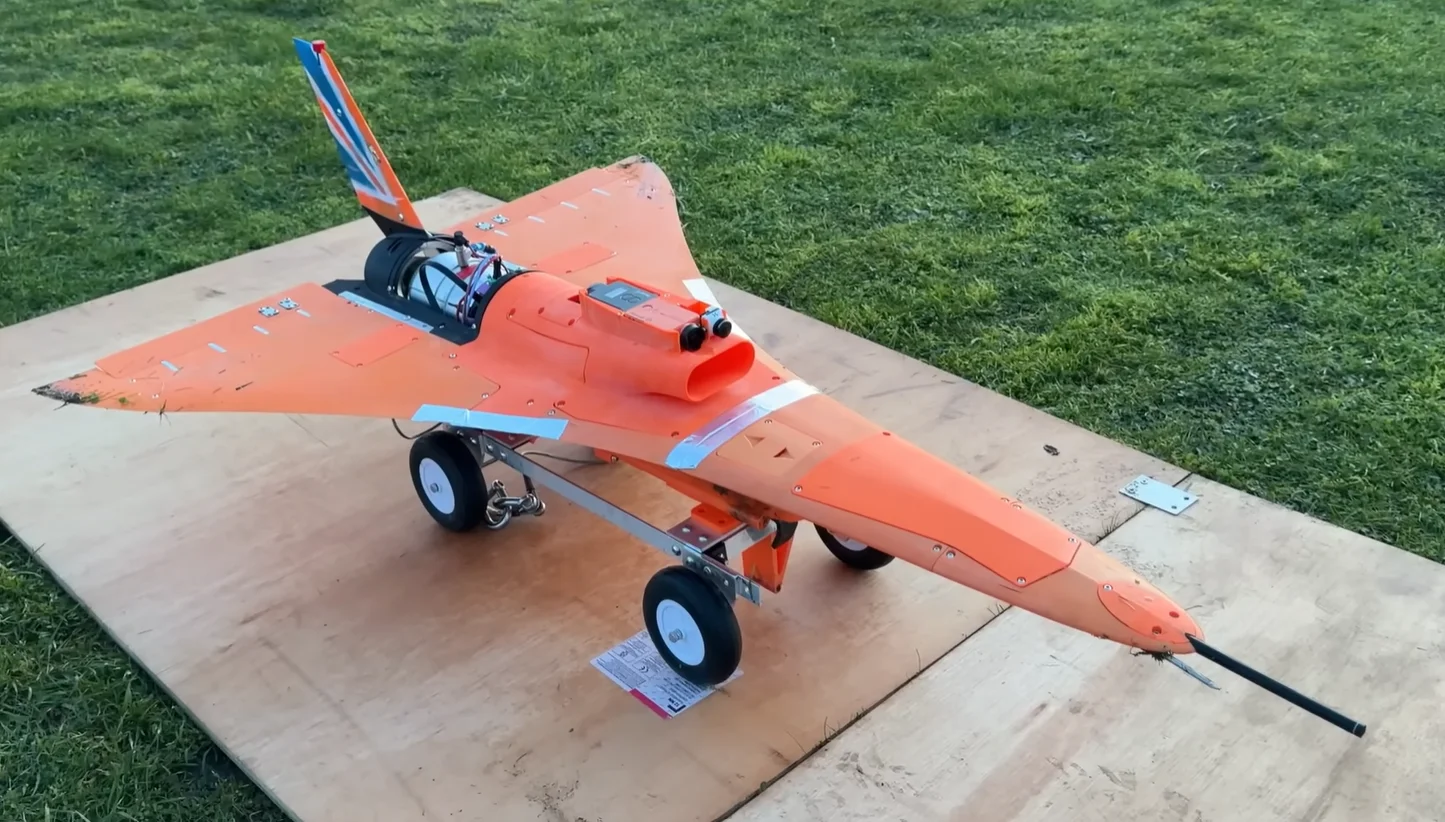
A mostly PETG remote-controlled jet is at the center of a bid to break the model aircraft speed record. Built by The Mach Initiative, a team of University of Bath graduates, the Kingchaser pairs printed bodywork with carbon fiber reinforcement and metal engine mounts, targeting Mach 0.8.
The 9 kg aircraft is the latest step in a development program that began with a smaller electric prototype. Its construction shows how the team has retained printed parts while changing the structure, engine housing and heat protection to accommodate a larger turbine-powered design.
Kingchaser’s record attempt is still ahead
Tom’s Hardware reports that the team wants to beat a Guinness World Record held for nine years by German pilot Neils Herbrich. For historical context, BroBible’s October 2017 report described a turbine-powered RC model setting a record at 451 mph, or 727 km/h.
The flight milestone needs some qualification. Tom’s Hardware describes Kingchaser as having completed its maiden flight, but also identifies the team’s maiden-flight video as showing its predecessor, Kingfisher. The account is inconsistent on which aircraft has flown, leaving Kingchaser’s own maiden-flight status unclear.
No date has been announced for the record attempt.
An electric prototype made iteration cheaper
The project started with Kinglet, a miniature prototype built from PETG, PET-CF and some PLA. Rather than begin with a turbine, the team used an electric ducted fan as a safer, lower-cost way to iterate.
Kinglet’s modular construction let the engineers revise individual sections and replace damaged parts without rebuilding the entire aircraft. That approach gave the team a way to develop the design before moving to jet propulsion.
The next aircraft, Kingfisher, measured just under a meter and used a Jetcat P60 miniature turbine. Its reported top speed was 205 mph, or 330 km/h. The Mach Initiative described this aircraft’s purpose as achieving turbine-powered flight, with the record attempt reserved for a later design.
Kingfisher retained a mainly PETG body, but added an annealed PET-CF engine housing, aluminum engine hardware and an aluminum skeleton. Moving beyond Kinglet required substantial changes to handle the larger aircraft and higher loads.
A warped housing prompted a material change
The team initially planned to use a Kingfisher MK2 for the record bid, then opted for a separate aircraft with significant design changes. Kingchaser is 20% larger than Kingfisher and weighs about 20 lb, or 9 kg.
PETG still makes up most of its exterior. Around the engine, however, the team switched from annealed PET-CF to PPS-CF after annealing the larger housing caused warping, possibly because of uneven heating.
The PPS-CF housing is skinned with several layers of carbon fiber. Aluminum and steel reinforce the engine mounting, while titanium exhaust sheets and aluminum tape shield the printed structure from turbine heat.
Elsewhere, carbon fiber rods replace Kingfisher’s aluminum skeleton. The change reduces weight and cuts the number of custom CNC-machined parts needed for the aircraft.
Telemetry and high-torque controls support the speed bid
Kingchaser also carries a fully instrumented avionics system to collect flight telemetry. A dedicated flight-control and avionics team member handles the electronics, and an FPV system supports piloting at speed.
The elevons use servos rated at 70 kg-cm of torque to move the control surfaces against the substantial forces expected during high-speed flight. Alongside the revised structure and thermal protection, those controls are part of the engineering work needed to take the project beyond its smaller turbine demonstrator.